Caregiving rewires a life. Time gets chopped into alarms, appointments, and small negotiations: another bite of food, one more lap around the ward, a coaxed shower, a midnight blood sugar check. You learn the rhythms of pain medications and insurance portals, and often stretch beyond what your nervous system was built to carry for months or years. When the body stays braced like this, even love begins to feel like a marathon you did not train for. Somatic therapy helps caregivers build regulation from the inside out, so the caring can continue without burning the person who provides it.
I have sat with family caregivers in living rooms and hospital cafeterias, with chaplains in stairwells, with nurses on the curb after a code blue. The pattern repeats: people know what they should do for themselves, yet the nervous system keeps outrunning the plan. The head says “breathe,” the shoulders keep climbing toward the ears. This is not a character flaw. It is how bodies keep us moving through persistent demand. Regulation has to start in the body, in language the body understands.
What somatic therapy offers caregivers
Somatic therapy works directly with sensations, breath, posture, and movement to influence mood and stress response. That may sound simple, but for someone who hears their name called fifty times before lunch, simplicity is not a small thing. While traditional talk therapy can clarify beliefs and patterns, trauma therapy with a somatic lens also makes the nervous system itself a partner in change. Caregivers often arrive over-caffeinated, under-slept, and fully oriented to the needs of another person. Starting with the body is quick to access and does not require a quiet hour or a perfect plan.
I do not treat the caregiving role as a problem to solve. It is a relationship and, like any relationship, it shows you parts of yourself. Somatic work gives you a way to metabolize what you are asked to hold. Think of it as learning to widen the container so you can stay present without flooding or shutting down.
The nervous system in plain language
Caregiving tends to pull the autonomic nervous system into two patterns: overdrive and collapse. In overdrive, heart rate lifts, breathing stays shallow, muscles brace, and the mind races. This state can enhance focus in the short term, but over weeks it erodes sleep and makes irritability more likely. Collapse is the other pole. Energy tanks, appetite dips, choices feel numb, and guilt creeps in. Many caregivers ping-pong between the two, sometimes in a single afternoon.
Somatic therapy helps you sense which state you are in before it takes the wheel. Early markers show up as body cues: a sudden jaw clamp, heat in the chest, a hollow under the sternum, a frozen breath. Once you learn your map, you can intervene sooner with small, targeted adjustments. This is not about achieving constant calm. It is about mobility, the ability to move between states based on the moment’s need, then return toward a baseline that feels steady enough.
A realistic picture of the caregiving load
A daughter caring for her father with dementia may walk 8 to 10 miles a day inside a two-bedroom apartment, shepherding him away from the door. A pediatric oncology nurse covers 4 to 5 patients and speaks with three sets of anxious parents per shift, then commutes an hour home. A partner newly in the sandwich generation splits attention between a second grader and a mother in rehab after a hip fracture. Everyone in these examples is running a multi-front campaign: tasks, emotions, logistics, and money.
When there are so many fronts, self-care has to be built into what already exists. Forty-five minute practices are usually unsustainable. Somatic therapy for caregivers looks for wedge time, the 30 seconds between a doorbell and a response, the 90 seconds while hand sanitizer dries, the two minutes after you set a medication dispenser. We stack regulation into the day the way you tuck snacks into a backpack.
A short anatomy of support: movement, breath, and contact
Somatic therapy borrows from multiple traditions, but three domains consistently help caregivers.
Movement therapy. Small, intentional movements interrupt bracing and improve circulation. You do not need a mat or music. For example, on your way down a hallway, try two slow shoulder rolls, then a long arm reach that pulls the ribcage open. These moves cue the nervous system that you have room.
Breath. Not all breathing soothes. Long exhales tend to downshift the system, while fast forced inhales can spike alertness. For caregivers, I often teach ratio breathing that lengthens the out-breath without strain. If you are carrying heavy emotion, think of the exhale as a controlled pour, not a dump.
Contact. The body is organized by touch. A steady hand on your own chest while you talk to a doctor, a palm at the back of your neck while you wait on hold, a firm squeeze of your quadriceps before standing can recalibrate the sense of being in a body, not just watching it work.
Attachment needs do not pause during caregiving
Attachment therapy, which looks at how we formed early templates of safety and connection, becomes relevant when caregiving reactivates old patterns. A https://spiralsandheartspacehealing.com/ person with a more anxious attachment style may over-function, struggling to delegate or rest because stepping back feels like abandonment. Someone with an avoidant pattern might disconnect, handling tasks but missing the relational glue that keeps resentment from building.
Somatic approaches invite you to feel these patterns somatically rather than wrestle them only in your head. If you notice a surge of panic at the thought of asking a sibling to handle a weekend, watch where that panic lives. Does the belly clench, does the throat tighten, do shoulders pitch forward? If you tend toward distance when overwhelmed, you might register a coolness in the chest or a sense that your hands are far away. From there, we test small experiments. While making the ask, can you keep your feet pressing the floor and let your back widen against a chair? When sitting with your spouse after a hard appointment, can you let your shoulder rest into theirs for a count of five before any words?
No one chooses a nervous system template. You can, however, learn to care for the one you have so you relate to the person you love rather than to your fear.
Grief shows up early and often
Grief counseling is not just for after a death. Anticipatory grief lands the first time a diagnosis is spoken, the first time a parent does not remember your name, the day you realize the marathon will be years, not months. Grief feels different in the body than anxiety. In my office, grief often arrives as heaviness behind the eyes, a drop in the sternum, or a soggy kind of fatigue. Anxiety crackles. Grief drags.
Somatic therapy does not try to fix grief. It gives it shape so it can move. I might ask a caregiver to let the heaviness collect in one place, then give that place a posture, maybe a forward fold over the thighs for three breaths, then a slow rise. Or we place two hands on the ribs and feel how the back expands where the front cannot. One ICU nurse told me that on the drive home she pulls into the top level of the parking garage and does three slow standing bows to the horizon. It is not ceremony for show, just a private way to let the day exit through the body.
If tears threaten at inconvenient times, have a plan. Identify two safe zones where you can let emotion run for 90 seconds without apology. This might be a closed bathroom stall or the seat of your parked car. Build in a re-entry ritual, like cool water on your wrists or a slow count down your spine with your fingertips.
What changes when trauma is in the room
Many caregivers arrive with their own trauma history. Some have survived medical trauma themselves, others grew up in volatile households, others carry intergenerational echoes. Trauma therapy with a somatic frame respects that certain cues will light up the system in outsized ways. A beeping monitor may recall a past ICU stay. A raised voice in a rehab unit might trigger an old fear response. If this is you, it is not overreacting, it is an efficient nervous system doing its best with past data.
Work more gently. Start with neutral sensations rather than breath, which can be destabilizing for some trauma survivors. Track temperature at the fingertips, weight where thighs meet the chair, texture of fabric at the back of the knees. Keep eyes open. Orient the room by naming five colors or three rectangles you can see. Let movements be tiny and predictable. When possible, partner with a therapist trained in somatic and trauma therapy who understands paced titration, not catharsis.
Micro-practices that fit real schedules
The following are tiny, body-based practices I have tested with caregivers who could not sacrifice a full break. None is a cure. Together they build a scaffolding of regulation.
- The 4 to 7 pour: inhale for a count of 4, exhale for a count of 7. Do 3 rounds before making a difficult phone call. Fixed point gaze: choose a point on the wall and soften your eyes while keeping the point in view for 20 to 30 seconds. This settles visual scanning when you feel hunted by tasks. Hand bowl: cup one hand under your ribcage and the other at your mid-back, then breathe into the bowl for two breaths before you stand up with a heavy load. Heel rock: standing, shift weight slowly from heel to forefoot and back for six passes. It unlocks locked knees and lowers bracing. Name the good: silently label one thing that is not wrong in the next 10 feet of space. This interrupts threat dominance without pretending everything is fine.
A 90 second somatic pause you can use anywhere
When the nervous system spikes, most people try to reason their way down. It almost never works. Give yourself 90 seconds, which is long enough to ride a wave but short enough to be practical.
- Find a fixed surface for contact, such as a wall or the back of a chair. Place your palm against it with enough pressure to feel your shoulder blade engage. Without changing posture, feel three places your body meets support. It could be feet to floor, back to chair, hand to surface. Inhale gently through the nose, then let the exhale leave the mouth like a slow sigh, twice as long as the inhale. Do two cycles. Keep your eyes open. Name, in your head, two objects by color and shape, like “blue rectangle, silver circle.” Release the pressure of your palm by 10 percent and notice the subtle difference. Start your next action from this slightly softer state.
Practice this during neutral moments so your body reaches for it automatically when stress spikes.
Movement therapy tailored for caregiving bodies
Caregivers lift, twist, and hover a lot. That combination wrecks backs and necks. Movement therapy can be preventive medicine. Two clinical pearls from years in rehab units and living rooms: get the ribs moving, and keep the hips honest.
Rib glide. Stand with feet hip-width, place one hand on the lower left ribs. Slide the ribs to the right without hiking the shoulder, then to the left into your hand. Do 6 to 8 slow glides. This frees up breathing and takes pressure off the neck.
Hip hinge refresher. Most caregivers bend from the lower back because it feels like the shortest route. Instead, push your hips back as if closing a car door with your seat, keep the spine long, then stand by pressing through your heels. Practice five reps twice a day without a load, so the pattern is available when you pick up a human.
Neck decompression without cracking. Sit tall. Imagine a string lifting the crown of your head up a half inch. Keep the lift as you very gently tuck the chin like you are holding a peach under it. Three slow breaths. This resets the cervical stack that hours of vigilance jumbles.
These movements respect that you might only have two minutes. They do not require equipment and can be done in street clothes.
Boundaries that the body believes
People tell caregivers to set boundaries, as if the sentence alone erects a fence. Boundaries hold when the body can tolerate the discomfort of maintaining them. If you say no while your chest caves and your voice thins, others may unconsciously test the door.
Train the embodied yes and no. With a yes, feel your feet spread inside your shoes and let your chest widen a little. With a no, feel your back muscles switch on from shoulder to hip, and imagine the skin of your back getting one size larger. Practice these postures in a mirror with simple sentences like “I can help on Saturdays” and “I am not available at 7 p.m.” You are not faking confidence, you are giving your nervous system a cue that you can bear the micro-shock of disappointing someone.
Navigating medical systems without losing your center
Medical environments amplify activation. Fluorescent lighting, alarms, pagers, gowns that do not cover dignity. Somatic skills can protect your attention.
Arrive early enough to orient. Spend 45 seconds in the parking lot naming landmarks. When a conversation turns urgent, plant both feet, rest one hand on a knee, and lower your voice by half a notch. People match tone. Ask for momentary pauses in concrete terms: “Give me 20 seconds, I am writing.” If you need to advocate, pair strong eye contact with a low, slow exhale. The physiology of calm courage is contagious.
Edge case: if you are prone to dissociation in hospitals, keep a textured object in your pocket and switch it from hand to hand every minute. Eat something salty before a long appointment so your system has anchors other than adrenaline.
Caregiving and the long arc of identity
Prolonged caregiving reshapes identity. The person who handled global sales now measures success in successful showers. The runner becomes a scheduler. Anger and grief are part of the pivot. Somatic therapy lets identity move at the speed of the body. We test roles in posture and movement first. A man caring for his husband after a stroke practiced standing with one foot slightly forward, hands on hips, chest lifted 2 degrees, before asking his employer for a reduced workload. He said the new stance made a difference in his words. Not magic, just nervous system congruence.
When you want to reclaim a non-caregiving identity, do not wait for large blocks of leisure. Attach micro-rituals to existing transitions. If you loved gardening, brush your fingers through herbs by the kitchen sink while the kettle boils and breathe in the smell. If you used to salsa, stand while the soup simmers and shift weight to a slow beat for 30 seconds. Movement makes identity less theoretical.
Sleep that caregivers can actually get
Telling a caregiver to sleep more is like telling a fish to drink more water. The schedule may not allow it. Focus on sleep quality and pre-sleep downshifts. Avoid heavy cognitive tasks in the final 20 minutes before bed. Use a two-position night routine: seated for tasks like meds and alarms, then supine for downshift. In bed, place one palm on the belly, one on the heart, and breathe so the lower hand rises more than the upper. If thoughts race, give the mind a body-based job like counting four breaths into the belly, four into the low back, four into the sides of the ribs.

If you are up for nighttime care, treat the first return to bed as a reset. Two slow exhales longer than inhales, a gentle wiggle of the toes, and the sentence, spoken quietly, “Back to bed now.” Predictable cues help the body find the off-ramp faster.
When to seek more support
There is a line between high stress and a system that is failing. Seek professional help if you notice panic attacks that come from nowhere, persistent numbness that does not lift for days, startle responses that make ordinary life hard, or thoughts of self-harm. A therapist trained in somatic approaches can blend trauma therapy, attachment therapy, and grief counseling to fit your situation. Telehealth makes this more accessible, though keep in mind that privacy is essential. Even 30 minute sessions can move the needle when they are regular and somatically focused.
If you are a professional caregiver, advocate for movement therapy groups or brief regulation huddles on the unit. I have seen a charge nurse start shifts with 90 seconds of joint circles and two collective exhales. Morale did not skyrocket, but overtime injuries dropped and more people stayed for the post-shift debrief.
Cultural and family layers
Bodies learn culture. Some families treat stoicism as virtue. Some communities rightly distrust medical systems after generations of harm. Somatic therapy should never bulldoze these realities. Adapt practices to what feels honorable. If direct eye contact is disrespectful in your context, use a soft gaze. If public touch is not appropriate, emphasize weight and internal sensation. If prayers are part of your ritual life, pair them with breath and posture that restore you while aligning with your values.
In multigenerational homes where privacy is thin, choose signals that are both practical and discreet. A magnet on the fridge meaning “I need five minutes,” or a family agreement that whoever wears the blue scarf gets quiet space on the balcony until the scarf comes off. These are not luxuries. They are infrastructure.
What caregivers often teach me
Caregivers have shown me that tenderness and strength are not opposites, they are a hinge. One father who slept in a hospital recliner for 61 nights kept two habits no matter what the day brought. Each morning he stood at the window, placed both hands on the glass, and traced the skyline with his eyes. Each night, before closing them, he stretched his toes long under the thin blanket, then drew them back softly. He said it reminded him that he still reached and returned. That is regulation, lived.
Somatic therapy is less a set of tricks and more a way of relating to your body while you relate to the person you love. It is not another task to fail at. It is a way to feel your feet while you walk the longest halls of your life, to breathe a little more air into a day that offers too little, to let grief move and still find a way to laugh at a bad TV rerun with your mother.
If you care for someone, you are doing one of the hardest human jobs. Start small, and start with the body. Over time those seconds add up to a sturdier nervous system, fewer snapped words, steadier hands, and the simple miracle of staying kind inside a long demand.
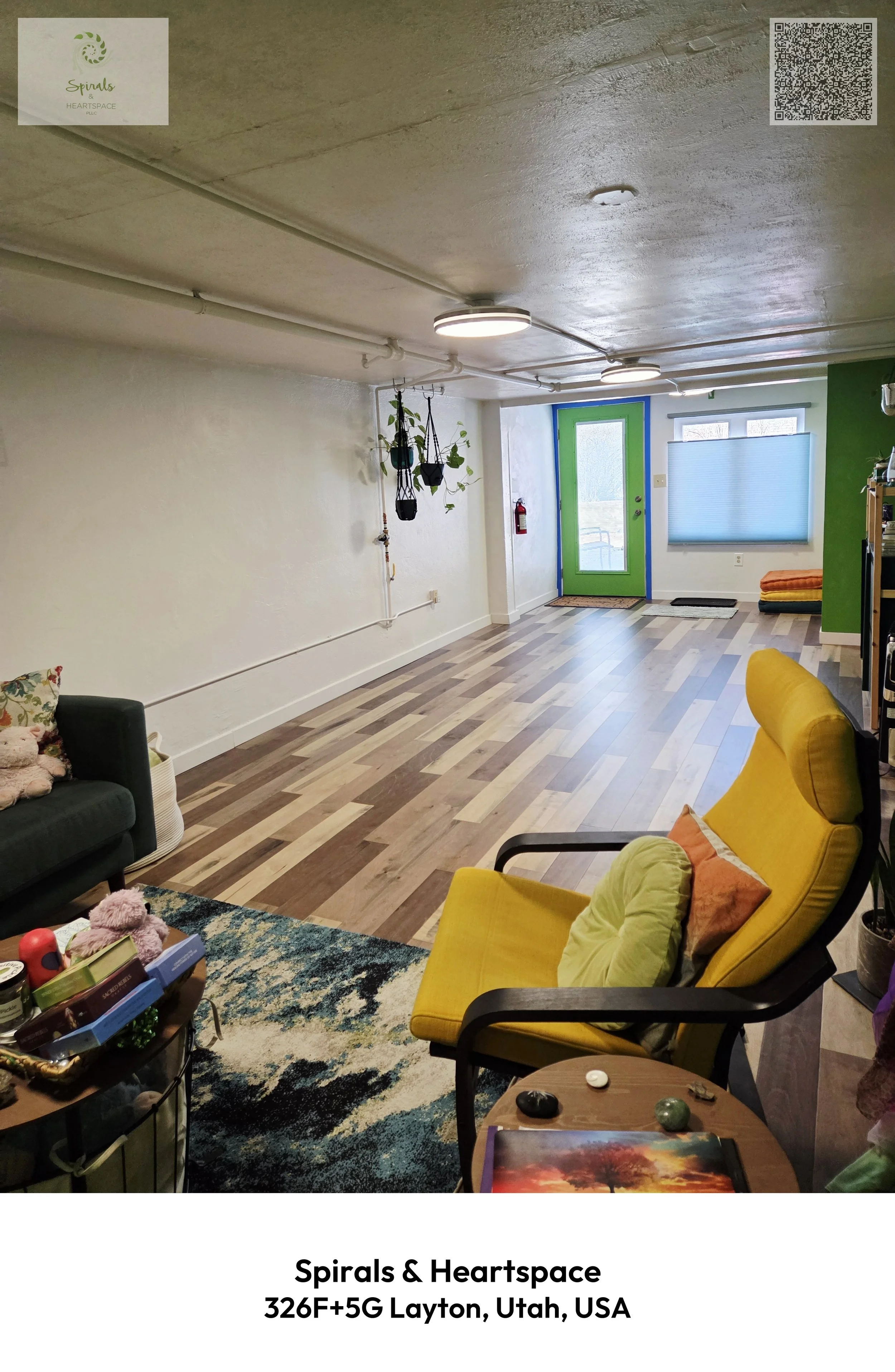
Spirals & Heartspace
Name: Spirals & HeartspaceAddress: 534 W Gentile St, Layton, UT 84041
Phone: (385) 301-5252
Website: https://spiralsandheartspacehealing.com/
Hours:
Sunday: Closed
Monday: 9:30 AM – 7:00 PM
Tuesday: 9:30 AM – 7:00 PM
Wednesday: 9:30 AM – 7:00 PM
Thursday: 9:30 AM – 7:00 PM
Friday: 9:30 AM – 7:00 PM
Saturday: Closed
Open-location code / plus code: 326F+5G Layton, Utah, USA
Coordinates: 41.0604503, -111.9762128
Map/listing URL: https://www.google.com/maps/place/Spirals+%26+Heartspace/@41.0604503,-111.9762128,766m/data=!3m2!1e3!4b1!4m6!3m5!1s0x875303311f1d4d1b:0xc6859e5e3fceafe2!8m2!3d41.0604503!4d-111.9762128!16s%2Fg%2F11x781dbvb
Embed iframe:
Socials:
Instagram: https://www.instagram.com/spiralsheartspace/
LinkedIn: https://www.linkedin.com/company/spirals-and-heartspace-pllc
TikTok: https://www.tiktok.com/@spiralsheartspace
X: https://x.com/SpiralsHea61786
YouTube: https://www.youtube.com/@SpiralsHeartspace
The practice is led by Ande Welling, a licensed clinical mental health counselor with training in dance/movement therapy, somatic work, EMDR, trauma care, relational neuroscience, and embodied attachment.
Listed services include therapy, coaching, consultation, authentic movement, trauma therapy, somatic therapy, grief counseling, movement therapy, and attachment therapy.
The practice serves adults who want a deeper body-aware approach to trauma, anxiety, depression, grief, burnout, self-abandonment, family patterns, and relationship wounds.
Spirals & Heartspace offers both in-person sessions in Layton and online therapy for clients in Utah.
The practice is locally positioned for clients in Layton, Kaysville, Farmington, Syracuse, Clearfield, Clinton, Roy, Ogden, Bountiful, Davis County, and nearby northern Utah communities.
The office is listed at 534 W Gentile St in Layton, with public listing hours Monday through Friday from 9:30 AM to 7:00 PM.
Prospective clients can call (385) 301-5252 or visit https://spiralsandheartspacehealing.com/ to ask about consultation options, session fit, and scheduling.
The public map listing for Spirals & Heartspace can help clients verify the Gentile Street office before planning an in-person appointment.
Popular Questions About Spirals & Heartspace
What is Spirals & Heartspace?
Spirals & Heartspace is a Layton, Utah psychotherapy and coaching practice offering somatic, trauma-focused, expressive arts, movement-based, and attachment-informed support for adults.
Who is the therapist at Spirals & Heartspace?
The official site identifies Ande Welling as the therapist, coach, movement facilitator, and guide behind Spirals & Heartspace. Listed credentials include LCMHC, BC-DMT, NCC, GL-CMA, BSE, EMDR Trained, and CCTP-II.
Where is Spirals & Heartspace located?
The matching public listing and LinkedIn profile list the address as 534 W Gentile St, Layton, UT 84041.
Does Spirals & Heartspace offer online therapy?
Yes. The official FAQ states that therapy is available in person or through a HIPAA-compliant telehealth platform for clients who live in Utah.
What services does Spirals & Heartspace provide?
Listed services include therapy, coaching, consultation, authentic movement, trauma therapy, somatic therapy, grief counseling, movement therapy, and attachment therapy.
What makes somatic therapy different from traditional talk therapy?
The official Layton page explains that somatic therapy works with body sensations, movement, and physical experience because trauma and emotional patterns can be held in the nervous system, not only in thoughts.
Do clients need dance experience for movement therapy?
No. The official Layton FAQ says no dance training or special physical ability is required, and that movement therapy uses a client’s natural capacity for movement to access emotions and process experiences.
Does Spirals & Heartspace accept insurance?
The official FAQ says the practice does not take insurance directly, but may provide superbills or bill for out-of-network benefits when applicable. Clients should confirm current reimbursement options directly before scheduling.
What are Spirals & Heartspace’s listed hours?
The matching public listing shows Monday through Friday from 9:30 AM to 7:00 PM, with Saturday and Sunday closed. Appointment availability should be confirmed directly.
How can I contact Spirals & Heartspace?
Call (385) 301-5252, visit https://spiralsandheartspacehealing.com/, or use the listed social profiles: https://www.instagram.com/spiralsheartspace/, https://www.linkedin.com/company/spirals-and-heartspace-pllc, https://www.tiktok.com/@spiralsheartspace, https://x.com/SpiralsHea61786, and https://www.youtube.com/@SpiralsHeartspace.
Landmarks Near Layton, UT
Spirals & Heartspace is located on West Gentile Street in Layton, Utah, with in-person therapy available locally and online therapy available for Utah residents. Clients near these landmarks can call (385) 301-5252 or visit https://spiralsandheartspacehealing.com/ to ask about somatic therapy, trauma therapy, movement therapy, grief counseling, attachment therapy, and consultation options.
- 534 W Gentile St — The listed office address for Spirals & Heartspace; clients can use the map listing to verify the office before visiting.
- West Gentile Street — The local street connected with the practice’s Layton office location.
- Downtown Layton — A practical local reference point for clients navigating central Layton.
- Layton Hills Mall — A major Layton shopping landmark and useful orientation point for clients traveling through the city.
- Interstate 15 near Layton — A major northern Utah route that helps clients reach Layton from nearby Davis County communities.
- Layton FrontRunner Station — A transit landmark for clients traveling by commuter rail through Davis County.
- Ellison Park — A local park and community landmark in Layton.
- Great Salt Lake Shorelands Preserve — A major natural landmark west of Layton and a recognizable Davis County destination.
- Hill Air Force Base — A major regional landmark near Layton and Clearfield.
- Kaysville — A nearby Davis County city listed in the practice’s surrounding service area.
- Farmington — A nearby Davis County community included in the broader local service-area language.
- Ogden — A nearby northern Utah city; clients can ask whether online Utah therapy or in-person Layton sessions are the best fit.